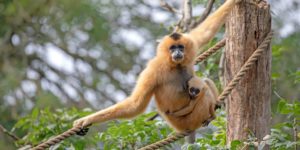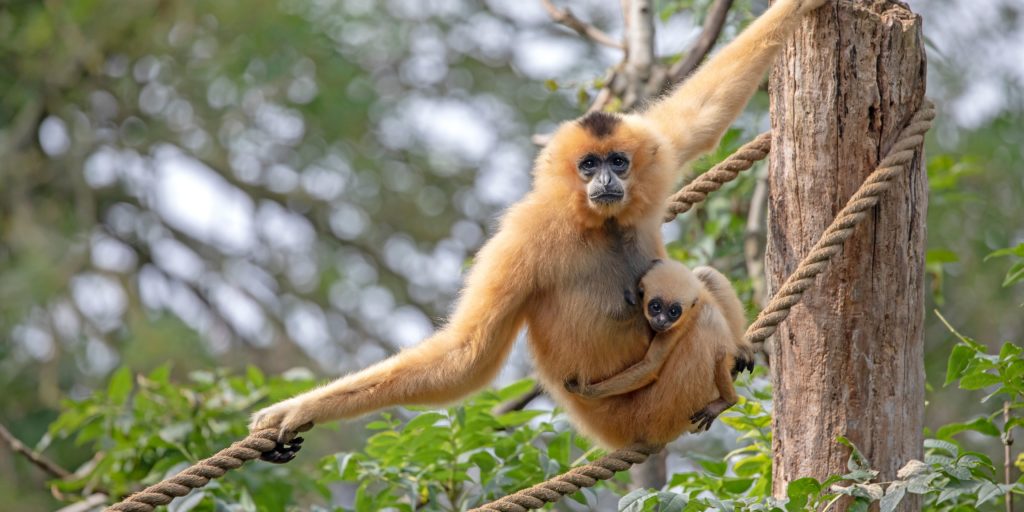
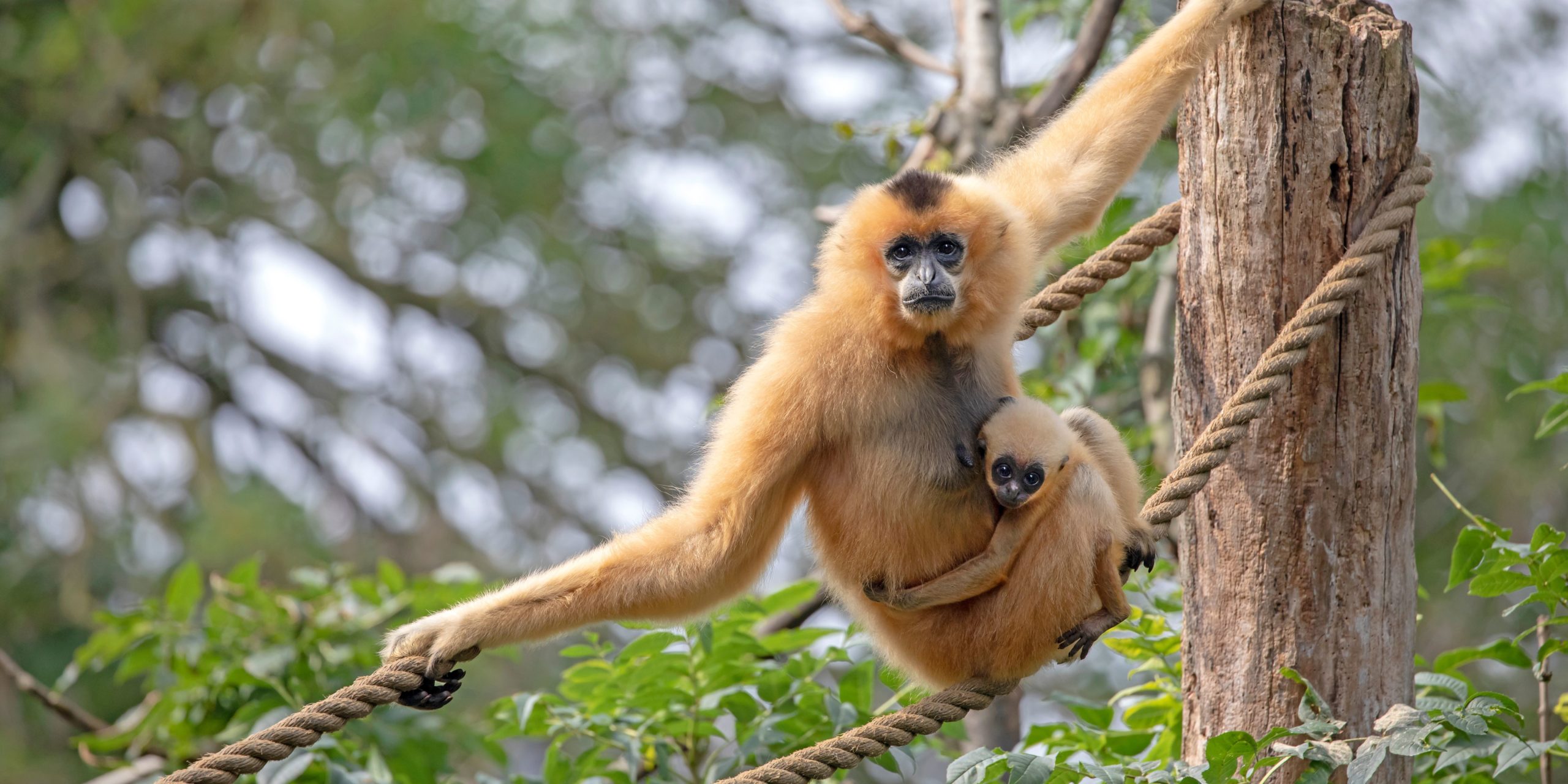
The Gibbon Rehabilitation Project (GRP) is a gibbon rehabilitation centre located in Phuket, Thailand. Since the 1990s, it has been working to reintroduce these monkeys into their natural habitat after they were taken from the wild and exploited in tourist circuits to satisfy the demand for souvenir photos – a practice that is now punishable by fines.
A rehabilitation mission
To capture a baby gibbon, poachers hunt down entire families in the forest. The adults are killed and the baby, if it survives a fall of up to 30 meters, is captured. It is then used as a tourist attraction: visitors pay to have their photo taken with it on beaches or in popular locations. This trivial gesture creates demand, which fuels a cruel trade.
Baby gibbons that join the GRP often arrive in critical condition: some die from stress, malnutrition or mistreatment in captivity. Those that survive sometimes have a chance to join the rehabilitation program after being seized from the tourist industry or recovered from the illegal pet market.
The process is long and gradual: it involves caring for them, re-adapting them to social life among their own kind, and above all desensitising them to human contact so that they can become fully-fledged wild animals once again.
In addition to animal welfare, the program also aims to preserve the ecosystem: gibbons play a crucial role in the rainforest, particularly by dispersing the seeds of the fruits they eat, thus contributing to the natural regeneration of the soil.
Since 2002, the GRP has enabled a gibbon population to be reborn in Phuket, thanks to the reintroduction of formerly captive individuals into their natural environment.
A complex and patient process
Rehabilitation cannot be improvised. When a new gibbon arrives at the centre, it first undergoes a quarantine period of at least three months, during which medical examinations (including a tuberculosis test) are carried out and antiparasitic treatments may be administered.
For some, this is the first time they have seen other gibbons since their capture. Each individual is placed in a separate cage, but can observe the others, learn by imitation, and begin to adopt more natural behaviours.
Contact with humans is strictly limited to avoid any emotional dependence that could compromise future reintroduction.
Behavioural and medical assessments are carried out every day. If the animal begins to show appropriate and independent behaviour, it can be transferred to a protected area of the forest.
Awareness and responsible tourism
The GRP is not a zoo: it is a conservation and education centre. Visitors are welcome, but they are not allowed to touch or feed the gibbons. The aim is to raise public awareness of the suffering caused by the illegal wildlife trade and to promote ethical and responsible tourism.
The GRP also warns against souvenir photos with baby gibbons, which are still common in Thailand and are almost always the result of cruel and illegal trafficking.
Concrete results
Since its creation, the GRP has rescued dozens of gibbons and released several entire families back into the wild. Each reintroduction is a victory, not only for the animal and its species, but also for the entire forest ecosystem.
However, the fight is far from over. The demand for gibbons as pets, combined with deforestation, continues to threaten their survival. Support for the GRP – through donations, sponsorships or volunteering – remains essential.
__________________
For more information
- Official website: www.gibbonproject.org
- Location: Gibbon Rehabilitation Project, Khao Phra Thaeo National Park, Phuket, Thailand
- Visits possible: Every day (except Thai public holidays)
- Admission: Fee required
Illustrative photo: @canva.com